
On the surface, cash often seems like the prudent choice. It doesn’t fluctuate like equities; it’s liquid, and in times of uncertainty, it’s natural for investors to seek refuge in cash. However, it is crucial to recognise that while cash is a safe haven and should be utilised in a portfolio, over time it can quietly but significantly erode your wealth.
It’s important for investors to understand that while cash is typically considered risk-free, it does carry inflation risk, opportunity cost, and potential tax inefficiencies that can undermine long-term financial goals.
Inflation
The main risk lies in inflation, which can quietly diminish the purchasing power of your money. Cash is often referred to as “lazy money” because it does nothing while inflation and time work against it. For example, in South Africa, inflation has averaged around 5.5% over the past 20 years, according to long-term data from the South African Reserve Bank (Sarb) and Stats SA.
This implies that R1 million held in cash could lose half its purchasing power within approximately 13 years at an average inflation rate of 5.5%. Even with the repo rate at 8.25% and money market yields ranging between 7% and 8.5%, the real after-tax returns, after accounting for income tax of 20% to 45% and inflation of around 5%, are often negligible or negative. This underscores the importance of allocating capital to inflation-beating investments to preserve and grow wealth over the long term.
Opportunity Cost:
According to data from Fidelity, had an investor contributed $5 000 annually into an all-stock portfolio between 1980 and 2023, the ending value, even with the worst possible market timing, would have been over $4.2 million. In contrast, contributing the same annual $5 000 into a cash account over the same period would have resulted in just $349 999. Moreover, when accounting for inflation, the investor holding cash would have experienced an average annual erosion of 3.5% (USD) in purchasing power. Simply put, the real-world cost of staying in cash was R3.85 million in lost growth potential.
Tax considerations:
Cash holdings are often taxed at an individual’s marginal income tax rate. In South Africa, there are annual exclusions of R23 800 (under 65) and R34 500 (Over 65). In contrast, dividends and capital gains are typically taxed at net effective tax rates. CGT has a net effective tax rate between 12% and 18%, while local and foreign dividends are taxed at 20%, and foreign dividends often have further tax deductions based on double tax agreements.
Investors looking to preserve capital while still generating returns above cash and inflation have a wide array of alternatives such as bonds, structured products and multi-asset portfolios.
Bonds are one of the most used alternatives to holding. Typically, bonds provide a higher yield to cash as they assume a higher risk. In South Africa, bond funds are currently delivering average returns of over 10.60% (ZAR) per annum-well above the rate of inflation and typical bank savings rates (Source: Coronation Fund Managers (2025)).
Structured products can also offer a higher return potential than cash. These investments are specifically designed to deliver fixed returns over a set term, often with built-in capital protection mechanisms that reduce downside risk.
While structured products do carry risk and are subject to market conditions and issuer creditworthiness, they offer a compelling balance of capital preservation and income generation.
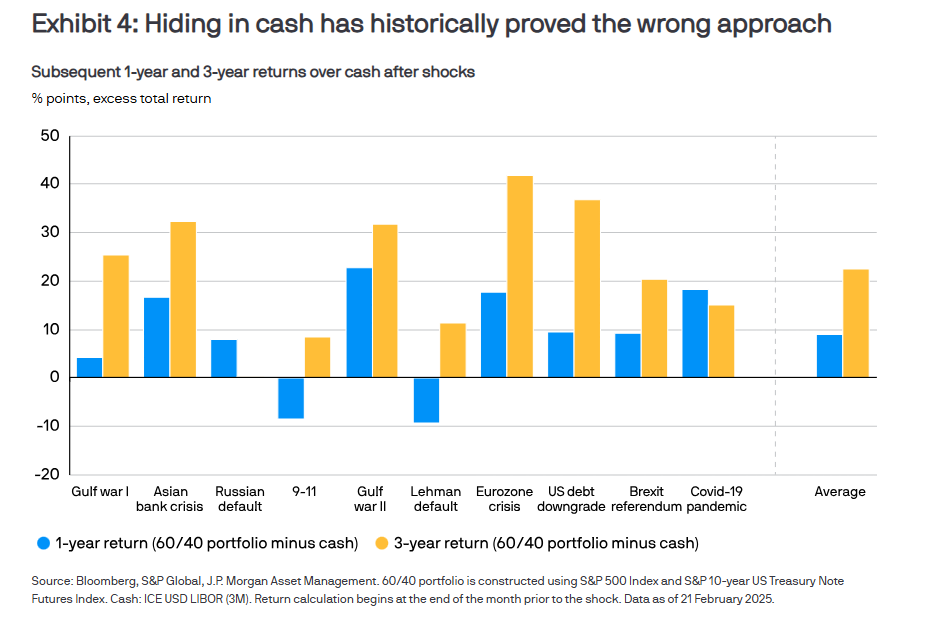
Multi-asset portfolios consisting of a diversified mix of equities, bonds, and inflation-hedging assets have consistently outperformed cash over time. According to research from Hartford Funds, a balanced 60/40 (equity/bonds) portfolio has outperformed cash in 75% of all one-year periods following major market shocks since 1990, and in 100% of three-year periods, with average excess returns of 9% (USD) and 20% (USD) respectively.
Conclusion
Investors must ask themselves: Why am I sitting in cash? Is it a deliberate wait for attractive entry points, a reaction to heightened market volatility, or simply an aversion to risk? While cash undeniably plays an important role in a well-structured portfolio — providing liquidity and flexibility — it should never become a long-term default position without strategic purpose.
There is nothing inherently wrong with holding liquid reserves to capitalise on market swings or seize tactical opportunities. However, it is critical to consider the alternatives. History consistently shows that the greatest long-term destroyer of wealth is not market volatility—it is inertia. Sitting on large cash balances while waiting for the “perfect moment” to invest often leads to missed gains and diminished financial outcomes. Market timing is exceptionally difficult, and evidence demonstrates that remaining invested, even through periods of uncertainty, delivers markedly better results over time.
Even Warren Buffett, frequently (and inaccurately) portrayed as a cash hoarder, emphasised in his most recent Berkshire Hathaway shareholder letter that the overwhelming majority of the firm’s capital remains allocated to equities — a stance, he affirmed, that “won’t change”.
While cash may provide a sense of safety, it should not become the default resting place for capital.
Money is meant to be productive; it should work actively on your behalf, not sit idle.
Today’s investors have access to a wide array of income-generating, capital-preserving, or growth-oriented strategies that can be aligned with individual financial goals and risk profiles. The key is to ensure each rand in your portfolio is intentionally positioned, contributing to your long-term wealth creation.
Article credit: https://www.moneyweb.co.za/financial-advisor-views/the-illusion-of-safety/